Meaning of ASTM A53 Grade A and ASTM A53 Grade B
ASTM A53 Grade A is a common grade of carbon steel pipe material, belonging to Grade A in the ASTM A53 standard. It is primarily used for low-pressure transmission, structural support, and general industrial piping systems. Simply put, it is a "general-purpose carbon steel pipe."
ASTM A53 Grade B is the most common grade of carbon steel pipe in the ASTM A53 standard.Compared to Grade A, Grade B has higher strength and is therefore more widely used in industrial projects.
The main difference between Grade A and Grade B lies in their mechanical properties, with Grade B having higher strength, which is why Grade B is more common in the market.
Grade A vs Grade B – What Is the Main Difference?
| Aspect | Grade A | Grade B |
| Mechanical Strength | Lower tensile and yield strength, suitable for light-duty applications | Higher tensile and yield strength, suitable for high-pressure systems |
| Chemical Composition | Lower carbon content, easier to form and weld | Slightly higher carbon and manganese content, improved strength and durability |
| Application Range | Low-pressure water systems, light structural use, general plumbing | Oil & gas pipelines, high-pressure fluid systems, industrial piping |
| Ductility vs Strength | Better ductility, easier bending and fabrication | Higher strength, slightly lower ductility |
| Cost & Efficiency | Lower cost, economical for non-critical applications | Higher cost but better safety, durability, and long-term performance |
ASTM A53 includes three types of steel pipes, namely Type F – Furnace-butt welded continuous Welded Pipe (Grade A), Type E – Electric Resistance Welded Pipe (Grade A and Grade B), Type S – Seamless Pipe (Grade A and Grade B).
The most fundamental difference between ASTM A53 Grade A and Grade B steel pipes is their mechanical properties, especially their minimum yield strength and tensile strength.This makes Grade B more suitable than Grade A for high pressure applications.
Yield Strength:
Yield strength is the critical stress value at which a material yields. (Note: Yield strength is only for elastic materials)
Grade B provides higher minimum yield strength, making it more resistant to deformation under pressure.
Typical values:
Grade A: ~205 MPa (30 ksi)
Grade B: ~240 MPa (35 ksi)
Tensile strength:
Tensile strength refers to the maximum stress a material can withstand before breaking.
Typical values:
Grade A: ~331 MPa (48,000 psi)
Grade B: ~414 MPa (60,000 psi)
Grade B steel pipe also generally has higher tensile strength than Grade A. Grade B steel pipe generally has a higher tensile strength than Grade A, making Grade B more suitable for applications that can withstand higher pressures.
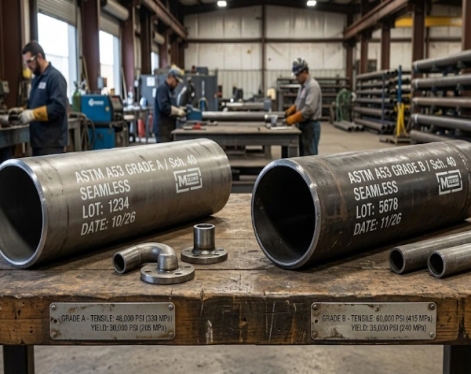
1.ASTM A53 Grade A vs B seamless steel pipes
|
Feature |
ASTM A53 Grade A |
ASTM A53 Grade B |
|---|---|---|
|
Material |
Carbon steel |
Carbon steel |
|
Manufacturing Process |
Seamless |
Seamless |
|
Applications |
Pressure piping systems (lower pressure), structural applications (non-critical), mechanical tubing (depending on wall thickness) |
Pressure piping systems (higher pressure), structural applications (non-critical), mechanical tubing (depending on wall thickness) |
|
Tensile Strength |
Minimum 48,000 psi (331 MPa) |
Minimum 60,000 psi (414 MPa) |
|
Yield Strength |
Minimum 30,000 psi (207 MPa) |
Minimum 35,000 psi (241 MPa) |
|
Pressure Withholding Capacity |
Lower |
Higher |
|
Cost |
Less expensive |
More expensive |
|
Additional Considerations |
Suitable for lower pressure applications, more cost-effective |
Suitable for higher pressure applications, offers higher strength and resistance to deformation |
|
Manufacturing Process Differences |
No additional elements or processing steps typically involved |
May involve alloying, heat treatment, or cold working to enhance strength |
|
Advantages |
More cost-effective |
Higher strength, better pressure resistance |
|
Disadvantages |
Lower strength, lower pressure resistance |
More expensive |
2.ASTM A53 Grades A and B Pipe - Permissible Variations
|
Attribute |
Permissible Variations for ASTM A53 Grade A and B Pipes |
|---|---|
|
Outside Diameter (OD) |
±1/64" (0.40mm) for sizes up to and including NPS 1-1/2" and ±1% of the specified O.D. for NPS 2" and above |
|
Wall Thickness |
Minimum wall thickness variation is typically 12.5% maximum |
|
Lengths |
Varies by manufacturer and specific product standards; refer to individual pipe length specifications |
|
Straightness |
The standard does not provide a specific value in the search results; refer to ASTM A53 for detailed straightness tolerances |
|
Weight per Foot |
Pipe shall not vary more than ± 10% from the standard specified weight |
FAQ
Q1: What is the main difference between ASTM A53 Grade A and Grade B?Grade B has higher yield and tensile strength, making it better for higher-pressure systems.
Q2: Is ASTM A53 seamless or welded?
Both. It includes Type S (seamless), Type E (ERW welded), and Type F (furnace welded).
Q3: Which one is stronger, Grade A or Grade B?
Grade B is stronger.