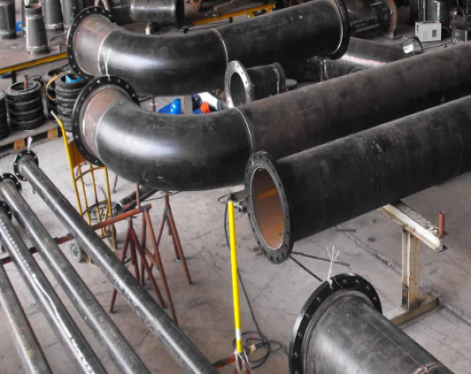
Under the requirements of the American Petroleum Institute and its API 5CT specification, N80 and P110 are two commonly used casing pipe grades in oil and gas well construction. Although both belong to API 5CT, they differ in strength level, application range, processing, cost, and performance capability.
What Is a Casing Pipe?
A casing pipe is a type of steel tubular product used in well construction for oil, gas, geothermal and other subsurface drilling projects. Its primary purpose is to support the wellbore, isolate subsurface pressure zones, prevent formation collapse, and protect freshwater zones from contamination. API Specification 5CT defines the standards for casing and tubing in oilfield applications, including chemical composition, mechanical properties, testing criteria, and connection types.Casing pipes are available in a range of steel grades — with N80 and P110 being among the most commonly specified for intermediate and deep wells due to their strength and performance characteristics.
API 5CT Casing Pipe Grades and Mechanical Properties
Under API 5CT, casing pipe grades are designated primarily by their minimum yield strength (the stress at which permanent deformation begins) and tensile strength. These values guide engineers in choosing the right steel grade based on downhole conditions.| Grade | Min Yield Strength (psi) | Typical Use |
| J55 / K55 | ~55,000 | Shallow, low pressure wells |
| N80 | ~80,000 | Medium depth, moderate pressure |
| L80 | ~80,000 | Corrosion resistance (H₂S/sour service) |
| P110 | ~110,000 | Deep, high pressure wells |
| Q125 | ~125,000 | Ultra-deep / high stress environments |
Grades like L80, C90, T95 and others add further specialized options, but N80 and P110 remain the most referenced in well planning for “standard vs high-performance” drilling designs.
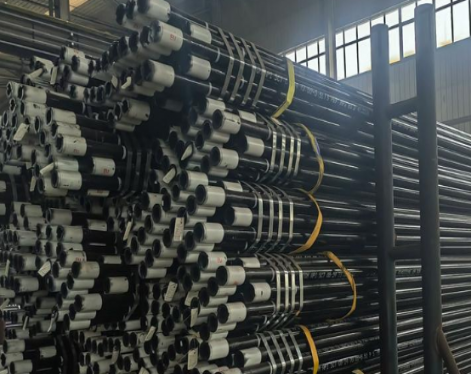
Below are the five key differences between N80 and P110 casing pipe.
1. Yield Strength
N80 has a minimum yield strength of 80,000 psi, while P110 reaches 110,000 psi. P110 provides significantly higher resistance to deformation under heavy loads and pressure.
2. Application Depth
N80 casing pipe is typically used in medium-depth wells with moderate pressure. P110 casing pipe is designed for deep or high-pressure high-temperature wells where greater structural strength is required.
3. Heat Treatment Process
N80 may be normalized or quenched and tempered depending on the type. P110 is fully quenched and tempered to achieve higher mechanical performance and toughness.
4. Cost Difference
N80 is more economical and widely used for standard drilling programs. P110 is more expensive due to stricter manufacturing control and higher strength requirements.
5. Collapse and Load Resistance
P110 casing pipe offers better collapse resistance and higher tensile load capacity, making it more suitable for long casing strings and demanding well conditions.
Conclusion
“API 5CT N80 vs P110 casing pipe” represents a core comparison in drilling engineering. N80 serves as a reliable, cost-effective choice for many medium depth wells, while P110 delivers high strength and resilience for deep, high-pressure environments.
By aligning your application requirements with the mechanical capabilities of each grade and adhering to API 5CT inspection standards, you can protect wellbore integrity, ensure safety and optimize project outcomes — all while improving your SEO visibility for the keyword casing pipe.