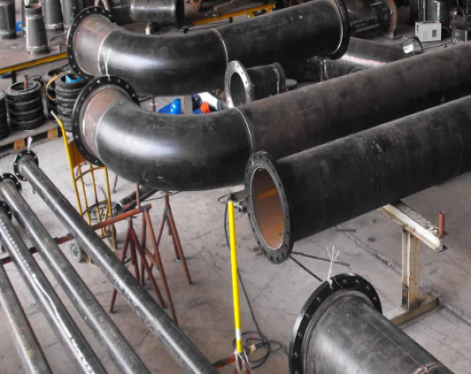
Hollow structural sections (HSS) play an irreplaceable role in the steel framework of modern buildings and infrastructure. They not only provide excellent structural support but also contribute to the clean, modern aesthetics of architecture. Globally, ASTM A500 is undoubtedly one of the most authoritative and widely adopted core standards in the HSS field.
It covers hollow structural sections (HSS) made from carbon steel.
These include:
Square Hollow Section (SHS)
Rectangular Hollow Section (RHS)
Round Hollow Section (CHS)
Moreover, these tubes are designed for load-bearing applications rather than fluid transport.
Forming Method: Primarily cold forming processes are used. Steel sheets or strips are rolled or bent into the desired shape at room temperature, and then longitudinally stitched together using high-frequency resistance welding (ERW) or submerged arc welding (SAW).
Flattening Test: This is a crucial test for uating weld quality and base material ductility. The standard specifies multi-stage flattening requirements; for example, when the plate spacing is compressed to 2/3 of the pipe diameter, no cracks should appear in the weld area; when compressed to 1/2, no cracks should appear in the base material area (except for very thin-walled pipes).
Surface Protection and End Treatment: Finished pipes are typically treated with black paint, oil, pre-galvanized, or hot-dip galvanized for corrosion protection. Pipe ends can be cut into flat, beveled (for easy on-site welding), or fitted with plastic caps for protection.
Building frames and columns
Bridges and support structures
Industrial platforms
Machinery frames
Towers and steel structures
They are preferred where strength and stability are critical.
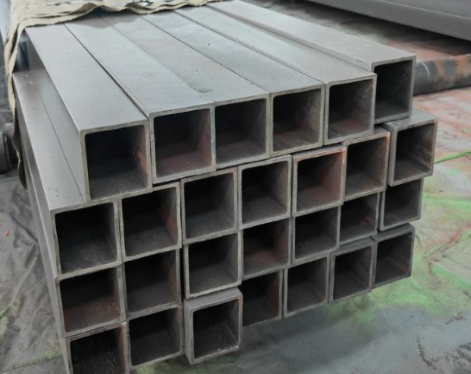
With strong mechanical properties and precise dimensional control, these hollow sections are essential in engineering applications.
Therefore, ASTM A500 remains one of the most important standards in structural steel construction worldwide.
What is ASTM A500 Hollow Section?
ASTM A500 is a structural steel specification.It covers hollow structural sections (HSS) made from carbon steel.
These include:
Square Hollow Section (SHS)
Rectangular Hollow Section (RHS)
Round Hollow Section (CHS)
Moreover, these tubes are designed for load-bearing applications rather than fluid transport.
ASTM A500 Hollow Section Specifications
Chemical Properties of ASTM A500 Steel Pipe
| Steel | Chemical composition % max. | Mechanical Property | ||||||||
| Grades | C | Mn | P | S | Cu | Tensile Strength | Tensile Strength | Yield Strength | Yield | Elongation in 2 in.(50mm) min, % |
| Mpa(Min) | psi (Min) | Mpa(Min) | Strength | |||||||
| psi (Min) | ||||||||||
| GR.A | 0.3 | 1.4 | 0.045 | 0.045 | 0.18 | 310 | 45000 | 230 | 33000 | 25 |
| GR.B | 0.3 | 1.4 | 0.045 | 0.045 | 0.18 | 400 | 58000 | 290 | 42000 | 23 |
| GR.C | 0.27 | 1.4 | 0.045 | 0.045 | 0.18 | 425 | 62000 | 315 | 46000 | 21 |
| GR.D | 0.3 | 1.4 | 0.045 | 0.045 | 0.18 | 400 | 58000 | 250 | 36000 | 23 |
Mechanical Properties of ASTM A500 Steel Pipe
| Round Structural Tubing | Grade A | Grade B | Grade C | Grade D |
| Tensile Strength, Minimum, psi [Mpa] | 45,000 [310] | 58,000 [400] | 62,000 [425] | 58,000 [400] |
| Yield Strength, Minimum, psi [Mpa] | 33,000 [230] | 42,000 [290] | 46,000 [315] | 36,000 [250] |
| Shaped Structural Tubing | Grade A | Grade B | Grade C | Grade D |
| Tensile Strength, Minimum, psi [Mpa] | 45,000 [310] | 58,000 [400] | 62,000 [425] | 58,000 [400] |
| Yield Strength, Minimum, psi [Mpa] | 39,000 [270] | 46,000 [315] | 50,000 [345] | 36,000 [250] |
ASTM A500 Hollow Section Manufacturing Process
To ensure the rock-solid quality of every HSS leaving the factory, ASTM A500 specifies a series of stringent manufacturing and testing processes:Forming Method: Primarily cold forming processes are used. Steel sheets or strips are rolled or bent into the desired shape at room temperature, and then longitudinally stitched together using high-frequency resistance welding (ERW) or submerged arc welding (SAW).
Flattening Test: This is a crucial test for uating weld quality and base material ductility. The standard specifies multi-stage flattening requirements; for example, when the plate spacing is compressed to 2/3 of the pipe diameter, no cracks should appear in the weld area; when compressed to 1/2, no cracks should appear in the base material area (except for very thin-walled pipes).
Surface Protection and End Treatment: Finished pipes are typically treated with black paint, oil, pre-galvanized, or hot-dip galvanized for corrosion protection. Pipe ends can be cut into flat, beveled (for easy on-site welding), or fitted with plastic caps for protection.
ASTM A500 Grades
ASTM A500 includes several strength grades:| Grade | Minimum Yield Strength | Application |
| Grade A | 33 ksi (228 MPa) | Basic structural use |
| Grade B | 42 ksi (290 MPa) | Most commonly used |
| Grade C | 46 ksi (317 MPa) | High-strength structures |
| Grade D | 58 ksi (400 MPa) | Special engineering use |
Applications of ASTM A500 Hollow Sections
ASTM A500 steel tubes are widely used in structural engineering:Building frames and columns
Bridges and support structures
Industrial platforms
Machinery frames
Towers and steel structures
They are preferred where strength and stability are critical.
Conclusion
The ASTM A500 hollow section specifications define a reliable standard for structural steel tubing.With strong mechanical properties and precise dimensional control, these hollow sections are essential in engineering applications.
Therefore, ASTM A500 remains one of the most important standards in structural steel construction worldwide.