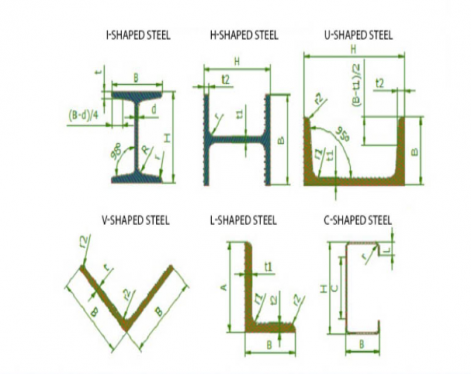
In the building materials market, structural steel has become an indispensable raw material in various structural and building projects. Among common structural steel sections, such as U-Beam, V-Beam, I-Beam, and H-Beam, two—I-Beam and H-Beam—are often easily confused due to their similar Beam. However, the differences between them lie not only in their shape but also in some important technical characteristics that determine their adaptability in use. Let's delve into each detail to better understand the differences between I-Beam and H-Beam steel sections.
In building structural design, H-Beam steel and I-Beam steel are two commonly used steel materials. They differ in shape, size, and application.
H-beams are steel with an H-shaped cross-section. Their characteristics include:
Large cross-sectional width and high bending strength: H-beams have a larger cross-sectional width, enabling them to withstand greater bending forces and exhibiting high bending strength.
High compressive strength: Due to their unique cross-sectional shape, H-beams fully utilize the compressive strength of steel, resulting in high load-bearing capacity.
Wide range of applications: H-beams are commonly used in industrial plants, long-span bridges, power towers, offshore drilling platforms, and other fields, meeting the structural requirements of various locations.
Characteristics of I-beams
I-beams are steel with an I-shaped cross-section. Their characteristics include:
Large cross-sectional height and high bending strength: I-beams have a larger cross-sectional height, enabling them to withstand greater bending forces and exhibiting high bending strength.
Lightweight: Compared to H-beams, I-beams have a more compact cross-sectional dimension and are lighter in weight, making them suitable for structural designs with high weight requirements.
Easy to construct: Due to the simple cross-sectional shape of I-shaped steel, it is easy to use and the processing and installation process is relatively simple.
The primary differences between H-shape steel beams and I-beams stem from their distinct cross-sectional shapes:
Flange Width: H-beams have significantly wider flanges compared to I-beams. This wider flange contributes to higher bending resistance and lateral stability.
Web Thickness: While both have a web connecting the flanges, the web thickness can vary. Generally, for beams of similar depth, H-beams might have a slightly thicker web, further enhancing their load-bearing capacity.
Shape and Manufacturing: H-beams are typically produced through a rolling process that results in a more uniform and robust cross-section. I-beams, particularly older ones, could be produced by riveting or welding separate pieces, though modern I-beams are also mostly rolled.
Strength and Stiffness: Due to their wider flanges, H-beams exhibit higher strength and stiffness, especially in bending about the strong axis (the axis parallel to the flanges).
Weight: For beams of similar depth, H-beams tend to be heavier than I-beams due to the increased material in the wider flanges.
Cost: Generally, H-beams are more expensive than I-beams due to the more complex manufacturing process and increased material usage.
In summary, H-beams and I-beams differ in cross-sectional shape, dimensions, and applications. H-beams are suitable for applications requiring high bending strength and compressive capacity, such as industrial plants and bridges; while I-beams are suitable for structural designs with high weight requirements, such as high-rise buildings and lightweight steel structures.
In building structural design, H-Beam steel and I-Beam steel are two commonly used steel materials. They differ in shape, size, and application.
What is an H-Beam?
H-beams are shaped like an H. H-beams are structural beams made of rolled steel. It is incredibly strong. It gets its name because it looks like a capital H over its cross-section.What is an I-Beam?
An I-beam, on the other hand, has a cross-section resembling the letter “I.” Similar to an H-beam, it comprises two horizontal flanges and a vertical web. However, the flanges of an I-beam are narrower and often tapered. This shape makes I-beams more suitable for applications where bending is primarily in one direction and where weight is a significant concern.Differences Between I-Beam and H-Beam
Characteristics of H-beamsH-beams are steel with an H-shaped cross-section. Their characteristics include:
Large cross-sectional width and high bending strength: H-beams have a larger cross-sectional width, enabling them to withstand greater bending forces and exhibiting high bending strength.
High compressive strength: Due to their unique cross-sectional shape, H-beams fully utilize the compressive strength of steel, resulting in high load-bearing capacity.
Wide range of applications: H-beams are commonly used in industrial plants, long-span bridges, power towers, offshore drilling platforms, and other fields, meeting the structural requirements of various locations.
Characteristics of I-beams
I-beams are steel with an I-shaped cross-section. Their characteristics include:
Large cross-sectional height and high bending strength: I-beams have a larger cross-sectional height, enabling them to withstand greater bending forces and exhibiting high bending strength.
Lightweight: Compared to H-beams, I-beams have a more compact cross-sectional dimension and are lighter in weight, making them suitable for structural designs with high weight requirements.
Easy to construct: Due to the simple cross-sectional shape of I-shaped steel, it is easy to use and the processing and installation process is relatively simple.
The primary differences between H-shape steel beams and I-beams stem from their distinct cross-sectional shapes:
Flange Width: H-beams have significantly wider flanges compared to I-beams. This wider flange contributes to higher bending resistance and lateral stability.
Web Thickness: While both have a web connecting the flanges, the web thickness can vary. Generally, for beams of similar depth, H-beams might have a slightly thicker web, further enhancing their load-bearing capacity.
Shape and Manufacturing: H-beams are typically produced through a rolling process that results in a more uniform and robust cross-section. I-beams, particularly older ones, could be produced by riveting or welding separate pieces, though modern I-beams are also mostly rolled.
Strength and Stiffness: Due to their wider flanges, H-beams exhibit higher strength and stiffness, especially in bending about the strong axis (the axis parallel to the flanges).
Weight: For beams of similar depth, H-beams tend to be heavier than I-beams due to the increased material in the wider flanges.
Cost: Generally, H-beams are more expensive than I-beams due to the more complex manufacturing process and increased material usage.
| Feature | H Beam | I Beam |
| Shape | H-shaped cross section | I-shaped cross section |
| Flange Width | Wider | Narrow |
| Web Thickness | Thick | Thin |
| Load Capacity | Higher | Moderate |
| Structural Stability | Stronger | Lower than H beam |
| Typical Use | Heavy construction | Light to medium structures |
In summary, H-beams and I-beams differ in cross-sectional shape, dimensions, and applications. H-beams are suitable for applications requiring high bending strength and compressive capacity, such as industrial plants and bridges; while I-beams are suitable for structural designs with high weight requirements, such as high-rise buildings and lightweight steel structures.