API 5DP is a technical standard for steel drill pipe developed by the American Petroleum Institute (API). It aims to regulate the manufacturing, testing, and performance requirements of drill pipe in the oil and gas industry. Since its initial publication in 2009, this standard has become a core reference in the global oil and gas drilling and production field. The following analysis covers its standard system, technical requirements, testing specifications, and industry trends.
API 5DP specifies the technical delivery conditions for steel drill pipes with thickened bodies and welded joints, applicable to drilling, completion, and production operations. Its core content includes product specification grades (PSL-1, PSL-2, PSL-3), steel grade classifications (E, X, G, S, etc.), and dimensional tolerance requirements.
PSL Grade Classification:
PSL-1: Basic grade, covering standard drill pipe performance requirements.
PSL-2/PSL-3: Higher requirement grades, adding additional conditions such as low-temperature impact toughness and flaw detection frequency (e.g., PSL-3 requires full-size hardness testing).
2. Version Updates and International Integration
First Edition (2009): Equivalent to ISO 11961:2008, integrating the original API 5D and API 7 standards, and introducing the PSL grading system for the first time.
Second Edition (2020): Added errata sheets, strengthened digital labeling (QR code traceability) requirements, and improved full lifecycle management capabilities. Coordination with ISO standards: API 5DP maintains technical consistency with ISO 11961, but adds regional requirements such as API monogram certification.
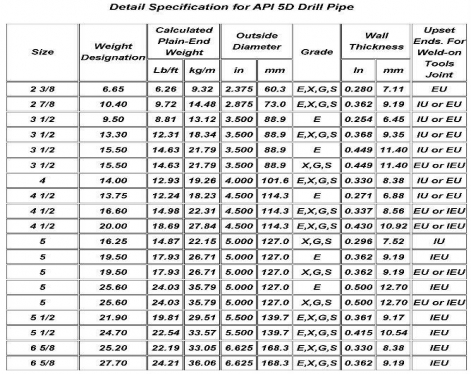
API 5DP Drill Pipe Dimensions
API 5DP refers to the drill pipe specification published by the American Petroleum Institute, which defines manufacturing requirements for drill pipes used in oil and gas drilling.
What are the common grades of API 5DP drill pipe?
The most common grades include:
E75
X95
G105
S135
Each grade provides different strength levels for various drilling conditions.
What is the standard length of API drill pipe?
The most common length is Range 2 (27–31 ft), widely used in oilfield drilling operations.
Why is API certification important for drill pipe?
API certification ensures that the pipe meets strict standards for quality, safety, and performance, which is critical for high-risk drilling environments.
API 5DP Standard System and Version Evolution
1.Standard Positioning and Scope of Application:API 5DP specifies the technical delivery conditions for steel drill pipes with thickened bodies and welded joints, applicable to drilling, completion, and production operations. Its core content includes product specification grades (PSL-1, PSL-2, PSL-3), steel grade classifications (E, X, G, S, etc.), and dimensional tolerance requirements.
PSL Grade Classification:
PSL-1: Basic grade, covering standard drill pipe performance requirements.
PSL-2/PSL-3: Higher requirement grades, adding additional conditions such as low-temperature impact toughness and flaw detection frequency (e.g., PSL-3 requires full-size hardness testing).
2. Version Updates and International Integration
First Edition (2009): Equivalent to ISO 11961:2008, integrating the original API 5D and API 7 standards, and introducing the PSL grading system for the first time.
Second Edition (2020): Added errata sheets, strengthened digital labeling (QR code traceability) requirements, and improved full lifecycle management capabilities. Coordination with ISO standards: API 5DP maintains technical consistency with ISO 11961, but adds regional requirements such as API monogram certification.
API 5DP Drill Pipe Grades
The API 5DP specification defines several steel grades used for manufacturing drill pipes. Each grade represents a different yield strength level, allowing engineers to choose the most suitable pipe for different drilling depths and conditions.| Grade | Minimum Yield Strength | Typical Application |
| E75 | 75,000 psi | Shallow wells and light drilling operations |
| X95 | 95,000 psi | Medium-depth wells |
| G105 | 105,000 psi | Deep drilling environments |
| S135 | 135,000 psi | Ultra-deep wells and high torque drilling |
API 5DP Drill Pipe Dimensions
API 5DP Drill Pipe FAQ
What does API 5DP mean?API 5DP refers to the drill pipe specification published by the American Petroleum Institute, which defines manufacturing requirements for drill pipes used in oil and gas drilling.
What are the common grades of API 5DP drill pipe?
The most common grades include:
E75
X95
G105
S135
Each grade provides different strength levels for various drilling conditions.
What is the standard length of API drill pipe?
The most common length is Range 2 (27–31 ft), widely used in oilfield drilling operations.
Why is API certification important for drill pipe?
API certification ensures that the pipe meets strict standards for quality, safety, and performance, which is critical for high-risk drilling environments.