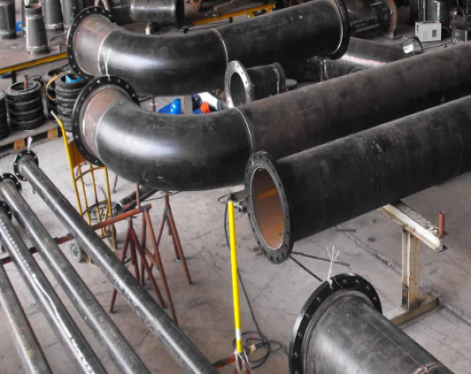
API 5L standard LSAW pipes are used for transporting oil, natural gas, water, offshore pipelines, and structural support applications.
Because they are manufactured from a single steel plate formed into a cylindrical shape and welded along a single longitudinal seam using the highly reliable submerged arc welding process, they offer unparalleled dimensional stability and mechanical strength.So, where exactly do we see these steel giants in action? Let’s break down the primary applications of API 5L Standard LSAW line pipes.
What Is API 5L and LSAW Line Pipe?
API 5L is the global benchmark specification for line pipe used for transporting oil, natural gas, and water. It covers both seamless and welded steel pipe types.API 5L Scope and Grades
API 5L defines requirements for steel chemical composition and mechanical performance.
Pipe grades range from Grade B up to X80, where “X” grades indicate higher yield strength for tougher environments.
Two quality levels exist: PSL1 (standard) and PSL2 (enhanced), with PSL2 involving stricter testing and traceability.
Applications of API 5L LSAW Line Pipe
API 5L LSAW line pipes are highly versatile and widely used in energy, infrastructure, and industrial projects. Their high strength, large diameter, and pressure rating make them ideal for critical pipeline systems.1. Onshore Oil and Gas Long-Distance Pipelines: The "main artery" for transnational oil and gas transportation, large diameter (16"-56") and high strength (X52-X80) meet the requirements of high pressure (over 10MPa) and large flow. Examples include natural gas trunk lines (X60-X80, wall thickness 10-40mm) and crude oil export lines (X52-X70, wall thickness 8-30mm), with single longitudinal seam + 100% UT/RT testing to ensure sealing.
2. Offshore and Submarine Pipelines: Used for subsea oil/gas risers and platform pipelines, thick walls (30-50mm) resist internal and external pressure, with an outer wall coated with 3LPE or concrete for corrosion protection, such as the export pipelines from the South China Sea deep-water gas field.
3. Bridge and Building Pile Foundations: Used for large bridges (such as the Hong Kong-Zhuhai-Macau Bridge) and building pile foundations, with high roundness (ellipticity ≤1%) and excellent straightness, thick walls (20-40mm) to bear tens of thousands of tons of load, and resistance to buckling when driven into complex strata. 4. Large-scale water conveyance and hydroelectric pressure steel pipes: Municipal inter-basin water transfer (e.g., South-to-North Water Transfer Project, Grade B/X42, diameter 1-3 meters, smooth inner wall for energy saving); hydroelectric pressure steel pipes (e.g., Three Gorges X65, wall thickness 30-50mm) withstand static pressure from hundreds of meters of water head.
5. Heavy-duty structures and industrial manufacturing: Used in wind turbine towers, mining machinery, and chemical high-pressure equipment; high forming precision (diameter tolerance ±0.75%), compatible with X70/X80 steel grades.
Chemical Composition and Mechanical Properties of API 5L Standard LSAW Line Pipe
| Grade | C max (%) | Mn max (%) | P max (%) | S max (%) | Yield Strength min (MPa) | Tensile Strength min (MPa) | Elongation min (%) | CVN Energy (J) at 0°C (PSL2) |
| API 5L Grade B (PSL1) | 0.28 | 1.2 | 0.03 | 0.03 | 245 | 415 | 27 | – |
| API 5L X52 (PSL2) | 0.24 | 1.4 | 0.025 | 0.015 | 360 | 460 | 22 | 27 avg / 20 min |
| API 5L X60 (PSL2) | 0.24 | 1.4 | 0.025 | 0.015 | 415 | 520 | 20 | 27 avg / 20 min |
| API 5L X70 (PSL2) | 0.24 | 1.4 | 0.025 | 0.015 | 485 | 570 | 18 | 27 avg / 20 min |
| GB/T 9711 L360 | 0.22 | 1.6 | 0.025 | 0.015 | 360 | 510 | 20 | As per standard |
How to choose API 5L steel grade?
API 5L steel grades (such as X52, X60, X65, X70, X80, etc.) essentially define indicators such as minimum yield strength. When selecting a grade for an engineering project, the following should be considered simultaneously:Design pressure and pipe diameter - design wall thickness (the greater the wall thickness, the more sensitive it is to forming, expanding, welding, and transportation);
Field weldability and heat input window (higher steel grades are often more "process-dependent");
Toughness and fracture control requirements (low temperatures, dynamic loads, seismic zones, etc., significantly increase additional requirements);
Life cycle cost: Sometimes "increasing the steel grade by one level and reducing the wall thickness" can save on welding and corrosion protection area, but may lead to higher process and inspection costs; the overall cost needs to be calculated.