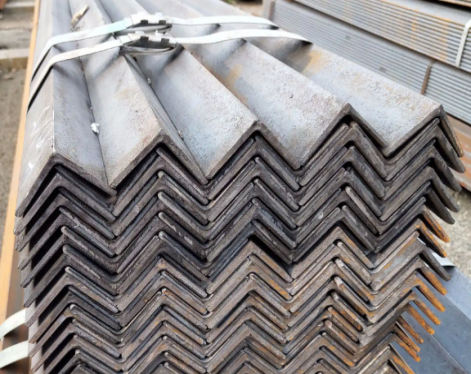
Mild steel angle steel, often called MS angle, is one of the most widely used structural steel products in construction, fabrication and industrial applications around the world. It has an L-shaped cross-section, providing excellent strength-to-weight characteristics, ease of fabrication and cost efficiency for structural support, framing and reinforcement work.
This product is available in equal angle (legs of the same length) and unequal angle (legs of different lengths), supporting a wide range of load-bearing and fabrication requirements
ASTM A36 – widely used structural quality mild steel
S235JR / S275JR – European structural grades
IS 2062 – Indian structural steel grade
JIS SS400 – Japanese structural grade
These grades are selected based on regional standards but typically share similar ductility, weldability and yield strength suitable for construction and fabrication.
Angle steel is divided into equal-sided angle steel (both legs have equal width) and unequal-sided angle steel (the two legs have unequal width). The dimensions are marked according to the principle of "side width × side width × side thickness" (equal-sided) or "long side width × short side width × side thickness" (unequal-sided), and the unit is millimeters (mm).
What Is Mild Steel Angle Steel?
Mild steel angle steel is manufactured from low carbon steel, typically conforming to standards such as ASTM A36, IS 2062 or EN-based specifications. Its “angle” shape consists of two perpendicular legs joined at a right angle, giving it good resistance to bending and torsion in structural uses.This product is available in equal angle (legs of the same length) and unequal angle (legs of different lengths), supporting a wide range of load-bearing and fabrication requirements
Common Grades of Mild Steel Angle Steel
While mild steel angle can be supplied in various material grades, some of the most common worldwide include:ASTM A36 – widely used structural quality mild steel
S235JR / S275JR – European structural grades
IS 2062 – Indian structural steel grade
JIS SS400 – Japanese structural grade
These grades are selected based on regional standards but typically share similar ductility, weldability and yield strength suitable for construction and fabrication.
Standard Dimensions and Sizes
Mild steel angles come in numerous standard sizes, often specified by the lengths of their legs and the thickness of the steel. Below are some typical dimension examples from standard weight charts:| Equal Angles, mild steel | ||||
| Size | Thickness | Size | Thickness | |
| mm | mm | mm | mm | |
| 20 x 20 | 3 | 75 x 75 | 6 | |
| 25 x 25 | 3 | 75 x 75 | 8 | |
| 25 x 25 | 5 | 75 x 75 | 10 | |
| 25 x 25 | 6 | 80 x 80 | 6 | |
| 30 x 30 | 3 | 80 x 80 | 8 | |
| 30 x 30 | 5 | 80 x 80 | 10 | |
| 40 x 40 | 3 | 80 x 80 | 12 | |
| 40 x 40 | 4 | 90 x 90 | 6 | |
| 40 x 40 | 5 | 90 x 90 | 8 | |
| 40 x 40 | 6 | 90 x 90 | 10 | |
| 45 x 45 | 3 | 90 x 90 | 12 | |
| 45 x 45 | 5 | 100 x 100 | 8 | |
| 45 x 45 | 6 | 100 x 100 | 10 | |
| 50 x 50 | 3 | 100 x 100 | 12 | |
| 50 x 50 | 5 | 100 x 100 | 15 | |
| 50 x 50 | 6 | 120 x 120 | 8 | |
| 50 x 50 | 8 | 120 x 120 | 10 | |
| 60 x 60 | 5 | 120 x 120 | 12 | |
| 60 x 60 | 6 | 120 x 120 | 15 | |
| 60 x 60 | 8 | 150 x 150 | 10 | |
| 60 x 60 | 10 | 150 x 150 | 12 | |
| 70 x 70 | 6 | 150 x 150 | 15 | |
| 70 x 70 | 8 | 200 x 200 | 16 | |
| 70 x 70 | 10 | 200 x 200 | 20 | |
| 200 x 200 | 24 | |||
Angle steel is divided into equal-sided angle steel (both legs have equal width) and unequal-sided angle steel (the two legs have unequal width). The dimensions are marked according to the principle of "side width × side width × side thickness" (equal-sided) or "long side width × short side width × side thickness" (unequal-sided), and the unit is millimeters (mm).