In the development of the construction industry, H-beams, as a new type of economical building steel, have become a core material for modern steel structure buildings due to their unique cross-sectional shape and superior mechanical properties. Compared with traditional I-beams, H-beams exhibit significant advantages in section modulus, structural stability, and construction efficiency, and are widely used in various building structures such as industrial plants, commercial buildings, and large bridges.
Based on the flange width, H-beams can be divided into three main categories: wide-flange (HW), medium-flange (HM), and narrow-flange (HN) H-beams.
HW-shaped steel has a height and flange width that are roughly equal. It is mainly used as a core column (also called a stiffened steel column) in reinforced concrete frame structures, primarily serving as a column in steel structures.
HM-shaped steel has a height-to-flange width ratio of approximately 1.33-1.75. It is mainly used as a steel frame column in steel structures, and as a frame beam in frame structures subjected to dynamic loads, such as equipment platforms.
HN-shaped steel has a height-to-flange width ratio greater than or equal to 2. It is mainly used in beam structures, and its use is equivalent to that of traditional I-beams.
Furthermore, based on different manufacturing processes, H-beams are also divided into hot-rolled H-beams and welded H-beams. Hot-rolled H-beams are produced using micro-alloying + TMCP technology and an intelligent cooling system, with tolerances exceeding industry standards, and a maximum web height of up to 1200 mm.
Large: H ≥ 700 mm (e.g., 700 × 300 mm), used for long-span bridges or high-rise building structures.
Medium-sized: 300mm ≤ H < 700mm (e.g., 500×200mm), commonly used in industrial plant frames.
Small-sized: H < 300mm (e.g., 200×200mm), mostly used for secondary components or mechanical supports.
2. Special-purpose steel:
Low-alloy H-beams (e.g., Q355B): High strength, good weather resistance, suitable for seismic fortification areas or heavy industrial environments.
Weathering/fire-resistant steel: Through alloy composition design, corrosion resistance or fire resistance is improved, used in chemical platforms or high-temperature workshops.
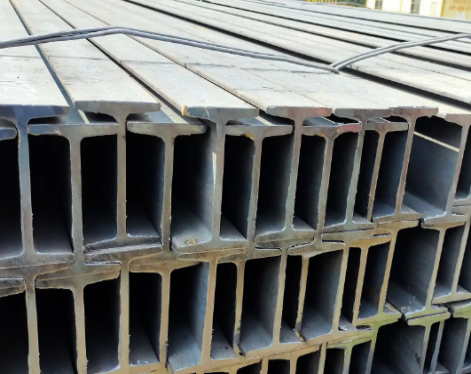
2. Welded H-beams: Welded from steel plates, different sizes and specifications can be customized according to specific needs.
Main Types of H-beams
The classification of H-beams is mainly based on four standards: flange width, manufacturing process, size specifications, and application. Through optimized design, their cross-sectional shape achieves a right-angle arrangement of the web and flanges, giving the structure higher bending strength and economy. Compared with traditional I-beams, H-beams have wider and more uniform flanges, facilitating connection and processing, and saving 10%–40% of steel.Based on the flange width, H-beams can be divided into three main categories: wide-flange (HW), medium-flange (HM), and narrow-flange (HN) H-beams.
HW-shaped steel has a height and flange width that are roughly equal. It is mainly used as a core column (also called a stiffened steel column) in reinforced concrete frame structures, primarily serving as a column in steel structures.
HM-shaped steel has a height-to-flange width ratio of approximately 1.33-1.75. It is mainly used as a steel frame column in steel structures, and as a frame beam in frame structures subjected to dynamic loads, such as equipment platforms.
HN-shaped steel has a height-to-flange width ratio greater than or equal to 2. It is mainly used in beam structures, and its use is equivalent to that of traditional I-beams.
Furthermore, based on different manufacturing processes, H-beams are also divided into hot-rolled H-beams and welded H-beams. Hot-rolled H-beams are produced using micro-alloying + TMCP technology and an intelligent cooling system, with tolerances exceeding industry standards, and a maximum web height of up to 1200 mm.
Classification by Size and Special Purpose
1. Size Classification (based on web height H):Large: H ≥ 700 mm (e.g., 700 × 300 mm), used for long-span bridges or high-rise building structures.
Medium-sized: 300mm ≤ H < 700mm (e.g., 500×200mm), commonly used in industrial plant frames.
Small-sized: H < 300mm (e.g., 200×200mm), mostly used for secondary components or mechanical supports.
2. Special-purpose steel:
Low-alloy H-beams (e.g., Q355B): High strength, good weather resistance, suitable for seismic fortification areas or heavy industrial environments.
Weathering/fire-resistant steel: Through alloy composition design, corrosion resistance or fire resistance is improved, used in chemical platforms or high-temperature workshops.
By production method:
1. Hot-rolled H-beams: Produced using hot rolling technology, with good mechanical properties and dimensional accuracy, a widely used type.2. Welded H-beams: Welded from steel plates, different sizes and specifications can be customized according to specific needs.