What are Z-shaped sheet piles? What are their uses in real life? Sheet piles are steel materials used in foundation engineering for revetment projects, mining projects, and sheet pile construction. They mainly include thin sheet piles, composite support piles, and tubular support piles. Z-shaped sheet piles are a type of sheet pile. They are hot-rolled structural steel with a Z-shaped cross-section and are mainly used in automobile manufacturing, railway engineering, steel structure construction, and bridge pier construction. Their interlocks are symmetrically distributed on both sides of the neutral axis, and the continuous web design increases the section modulus, thereby enhancing the wall's stiffness and resistance to deformation.
EN 10248 (Europe)
ASTM A572 / ASTM A328 (North America)
JIS standards (Asia)
Material grades are selected based on project requirements such as load capacity, corrosion resistance, and environmental exposure. For marine or coastal projects, corrosion-resistant steel or protective coatings are often applied to extend service life.
Z-type steel sheet piles, with their interlocking design at both ends, can construct continuous walls with large cross-sectional shapes. Compared to general steel sheet piles such as U-shaped steel sheet piles, they are lighter, have higher sectional performance, and are more efficient. This significantly reduces material costs while maintaining the same cross-sectional performance.
2. Shorter Construction Period
With the same linear length, the construction time can be shortened by reducing the number of Z-type steel sheet piles required for their larger cross-sectional shape, thus reducing the time spent on retrieving and driving the sheet piles.
3. Watertightness
With the same linear length, the construction time can be shortened by reducing the number of Z-type steel sheet piles, significantly reducing the potential for leakage in the interlocking sections, effectively suppressing leakage. Furthermore, the smaller gaps in the interlocking of GQNS-Z type sheet piles compared to existing cold-formed steel sheet piles result in superior watertightness.
4. Structural Reliability
The locking position of the Z-shaped sheet pile is located outside the central axis, and it is not affected by the longitudinal shear force generated near the central axis during bending deformation, thus preventing lock disengagement. It is a reliable product whose interface performance will not be degraded due to disengagement.
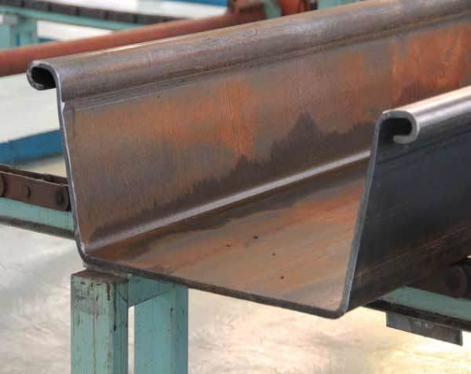
Z-shaped steel sheet piles are high-end steel products with high technological content and complex rolling processes. They offer advantages such as easy insertion and extraction, fast construction speed, strong load-bearing capacity, high safety performance, and long service life. They are widely used in bridge construction, coastal waterways, integrated utility tunnels, railways, and highways.
Large-size Z-shaped steel sheet piles have a large section modulus, high construction efficiency, and low project cost, saving at least 20% in construction costs compared to ordinary steel piles, making them more competitive in the market.
In terms of load-bearing capacity, Z-shaped steel sheet piles are more resistant to bending and more stable, requiring less steel under the same conditions, making them suitable for projects with high requirements such as deep foundation pits, wharves, and retaining walls. U-shaped steel sheet piles offer more flexible construction and lower costs, making them suitable for general or temporary support projects.
The application scenarios differ: Z-shaped piles are often used in long-term or important projects, especially hydraulic and marine engineering projects; U-shaped piles are commonly used in municipal engineering, trench support, and temporary cofferdams, offering good reusability.
When properly specified, manufactured, and installed, Z-shaped sheet piles deliver long-term structural stability and excellent economic value—meeting both technical and EEAT standards required by today’s global construction industry.
Z-Type Steel Sheet PilesManufacturing Standards and Materials
Z-shaped sheet piles are typically manufactured from high-strength carbon steel using hot-rolled or cold-formed processes. Common international standards include:EN 10248 (Europe)
ASTM A572 / ASTM A328 (North America)
JIS standards (Asia)
Material grades are selected based on project requirements such as load capacity, corrosion resistance, and environmental exposure. For marine or coastal projects, corrosion-resistant steel or protective coatings are often applied to extend service life.
Z-shaped steel dimensions and theoretical weight
Z-shaped steel: h - Height; b - Mid Flange; a - Small Flange; t - Thickness| Name | Size | |||
| h×b×a×t | h | b | a | t |
| 100×40×20×2.0 | 100 | 40 | 20 | 2 |
| 100×40×20×2.5 | 100 | 40 | 20 | 2.5 |
| 120×50×20×2.0 | 120 | 50 | 20 | 2 |
| 120×50×20×2.5 | 120 | 50 | 20 | 2.5 |
| 120×50×20×3.0 | 120 | 50 | 20 | 3 |
| 140×50×20×2.5 | 140 | 50 | 20 | 2.5 |
| 140×50×20×3 | 140 | 50 | 20 | 3 |
| 160×60×20×2.5 | 160 | 60 | 20 | 2.5 |
| 160×70×20×2.5 | 160 | 70 | 20 | 2.5 |
| 160×70×20×3.0 | 160 | 70 | 20 | 3 |
| 180×70×20×2.5 | 180 | 70 | 20 | 2.5 |
| 180×70×20×3.0 | 180 | 70 | 20 | 3 |
| 200×70×20×2.5 | 200 | 70 | 20 | 2.5 |
| 230×75×25×3 | 230 | 75 | 25 | 3 |
| 250×75×25×3 | 250 | 75 | 25 | 3 |
| 300×85×25×4 | 300 | 85 | 25 | 4 |
Features of Z-Type Steel Sheet Piles:
1. Economic EfficiencyZ-type steel sheet piles, with their interlocking design at both ends, can construct continuous walls with large cross-sectional shapes. Compared to general steel sheet piles such as U-shaped steel sheet piles, they are lighter, have higher sectional performance, and are more efficient. This significantly reduces material costs while maintaining the same cross-sectional performance.
2. Shorter Construction Period
With the same linear length, the construction time can be shortened by reducing the number of Z-type steel sheet piles required for their larger cross-sectional shape, thus reducing the time spent on retrieving and driving the sheet piles.
3. Watertightness
With the same linear length, the construction time can be shortened by reducing the number of Z-type steel sheet piles, significantly reducing the potential for leakage in the interlocking sections, effectively suppressing leakage. Furthermore, the smaller gaps in the interlocking of GQNS-Z type sheet piles compared to existing cold-formed steel sheet piles result in superior watertightness.
4. Structural Reliability
The locking position of the Z-shaped sheet pile is located outside the central axis, and it is not affected by the longitudinal shear force generated near the central axis during bending deformation, thus preventing lock disengagement. It is a reliable product whose interface performance will not be degraded due to disengagement.
Advantages of Z-shaped Steel Sheet Piles
Z-shaped steel sheet piles are constructed by connecting Z-shaped steel sheets in opposite directions using interlocking mechanisms to form a continuous wall. Due to their wide shape, Z-shaped steel sheet piles offer superior economic efficiency compared to ordinary steel sheet piles, while also shortening the construction period.Z-shaped steel sheet piles are high-end steel products with high technological content and complex rolling processes. They offer advantages such as easy insertion and extraction, fast construction speed, strong load-bearing capacity, high safety performance, and long service life. They are widely used in bridge construction, coastal waterways, integrated utility tunnels, railways, and highways.
Large-size Z-shaped steel sheet piles have a large section modulus, high construction efficiency, and low project cost, saving at least 20% in construction costs compared to ordinary steel piles, making them more competitive in the market.
Main Applications of Z-shaped Steel
Cold-formed Z-shaped steel offers advantages such as adjustable dimensions and high compressive strength. It is widely used in automobiles, railway vehicles, building doors and windows, transportation, shelving, electrical cabinets, highway guardrails, building steel structures, containers, steel formwork and scaffolding, solar panel supports, shipbuilding, bridges, power transmission towers, steel sheet piles, cable trays, agricultural machinery, furniture, warehousing, guide rails, keel steel, vegetable greenhouses, pipe supports, municipal construction, and other fields.What are the differences between Z-shaped and U-shaped steel sheet piles?
The most obvious difference between Z-shaped and U-shaped steel sheet piles is their shape. Z-shaped piles resemble the letter "Z," with the interlocking ends on both sides, resulting in more rational stress distribution and greater strength. U-shaped piles resemble the letter "U," with the interlocking end in the middle, resulting in relatively lower overall stiffness.In terms of load-bearing capacity, Z-shaped steel sheet piles are more resistant to bending and more stable, requiring less steel under the same conditions, making them suitable for projects with high requirements such as deep foundation pits, wharves, and retaining walls. U-shaped steel sheet piles offer more flexible construction and lower costs, making them suitable for general or temporary support projects.
The application scenarios differ: Z-shaped piles are often used in long-term or important projects, especially hydraulic and marine engineering projects; U-shaped piles are commonly used in municipal engineering, trench support, and temporary cofferdams, offering good reusability.
Conclusion
Z-shaped sheet piles are a high-performance steel piling solution designed for modern infrastructure and marine engineering projects. With their optimized cross-section, strong interlocks, and cost-effective material usage, Z type sheet piling continues to be a trusted choice for engineers worldwide.When properly specified, manufactured, and installed, Z-shaped sheet piles deliver long-term structural stability and excellent economic value—meeting both technical and EEAT standards required by today’s global construction industry.