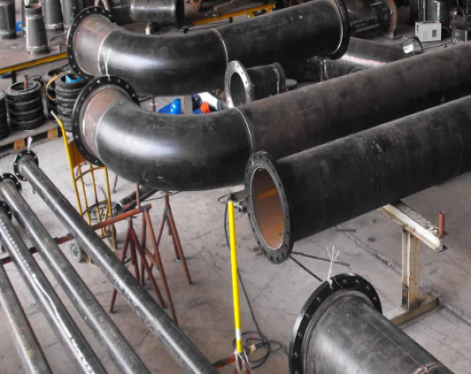
ASTM A500 Grade B Hollow Section is one of the most widely used structural steel materials in North America and global export markets. It is manufactured according to the standard issued by ASTM International under the specification ASTM A500, which covers cold-formed, welded, and seamless carbon steel structural tubing in round, square, and rectangular shapes.
Grade B is especially popular because it provides an ideal balance between strength, weldability, availability, and cost-efficiency, making it suitable for structural frameworks, buildings, bridges, towers, and mechanical applications.
Grade A
Grade B
Grade C
Grade D
Among these, Grade B is the most commonly specified for general structural use.
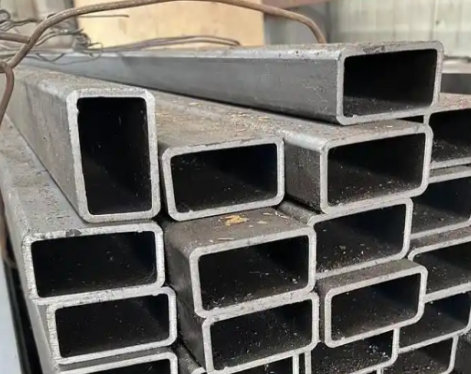
A500 square tubes have a square or rectangular cross-section. Compared to round tubes, they have superior bending and torsional resistance, making them widely used in building frames and mechanical equipment support structures.
Yield Strength (YS): ≥315 MPa (46 ksi), meaning the material undergoes only elastic deformation before being subjected to 315 MPa stress; beyond that, it enters the plastic deformation stage, ensuring the structure still has room for early warning deformation under overload.
Tensile Strength (TS): ≥400 MPa (58 ksi), the maximum load-bearing capacity before fracture, reflecting the material's limit against fracture.
Elongation: ≥21% (gauge length 50.8 mm), reflecting the material's plastic deformation capacity before fracture; the higher the value, the stronger the impact resistance and brittle fracture resistance.
Bending Performance: No cracks were observed in the 180° cold bending test (bending mandrel diameter = 3 times wall thickness), verifying the reliability of cold-formed processing.
Comparative advantages: Compared with Q235B (yield strength ≥235 MPa) in the national standard GB/T 6728, Grade B has a tensile strength that is about 27% higher. Under the same load, the cross-sectional size or wall thickness can be reduced, achieving lightweight design (for example, for beam members with the same load-bearing capacity, Grade B steel pipes can reduce weight by 15%-20% compared to Q235B steel).
Grade B is especially popular because it provides an ideal balance between strength, weldability, availability, and cost-efficiency, making it suitable for structural frameworks, buildings, bridges, towers, and mechanical applications.
What Is ASTM A500?
ASTM A500 is the Standard Specification for Cold-Formed Welded and Seamless Carbon Steel Structural Tubing in Rounds and Shapes. It covers four grades:Grade A
Grade B
Grade C
Grade D
Among these, Grade B is the most commonly specified for general structural use.
Basic Properties of ASTM A500 Structural Tube Material
A500 is a type of carbon structural steel in the American ASTM standard, primarily used for manufacturing cold-formed welded structural components. It is characterized by moderate strength, good weldability, and good plasticity and toughness. Depending on the grade (e.g., Gr.A, Gr.B, Gr.C), its yield strength and tensile strength will vary. For example, Gr.B typically has a yield strength of no less than 290 MPa and a tensile strength between 400-550 MPa.A500 square tubes have a square or rectangular cross-section. Compared to round tubes, they have superior bending and torsional resistance, making them widely used in building frames and mechanical equipment support structures.
Mechanical Advantages of ASTM A500 Grade B Structural Tubes
The mechanical properties of ASTM A500 Grade B are its core competitive advantage. Specific parameters are as follows (based on ASTM A500/A500M-22):Yield Strength (YS): ≥315 MPa (46 ksi), meaning the material undergoes only elastic deformation before being subjected to 315 MPa stress; beyond that, it enters the plastic deformation stage, ensuring the structure still has room for early warning deformation under overload.
Tensile Strength (TS): ≥400 MPa (58 ksi), the maximum load-bearing capacity before fracture, reflecting the material's limit against fracture.
Elongation: ≥21% (gauge length 50.8 mm), reflecting the material's plastic deformation capacity before fracture; the higher the value, the stronger the impact resistance and brittle fracture resistance.
Bending Performance: No cracks were observed in the 180° cold bending test (bending mandrel diameter = 3 times wall thickness), verifying the reliability of cold-formed processing.
Comparative advantages: Compared with Q235B (yield strength ≥235 MPa) in the national standard GB/T 6728, Grade B has a tensile strength that is about 27% higher. Under the same load, the cross-sectional size or wall thickness can be reduced, achieving lightweight design (for example, for beam members with the same load-bearing capacity, Grade B steel pipes can reduce weight by 15%-20% compared to Q235B steel).