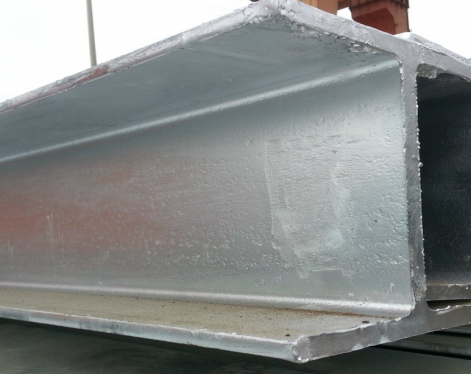
Galvanized H-beams are corrosion-resistant steel products obtained by hot-dip galvanizing ordinary H-beams. Essentially, a uniform and dense zinc-iron alloy protective film is formed on the surface of the H-beam (a hot-rolled profile with an "H" shaped cross-section), solving the corrosion problem of ordinary steel in humid and corrosive environments. This material combines the high strength and lightweight characteristics of H-beams with the excellent corrosion resistance of the galvanized layer, making it an indispensable material in modern steel structure engineering.
Galvanized H-beams are produced by hot-dip galvanizing (immersing the steel in molten zinc, allowing zinc atoms to penetrate and form an alloy layer), covering the surface with a zinc layer 45-85μm thick (the specific thickness is adjusted according to the application). This zinc layer not only isolates the H-beams from corrosive media such as air and water but also further enhances corrosion resistance through the "sacrificial anode" effect (zinc is more reactive than iron, preferentially corroding itself to protect the steel).
When the steel thickness of the H-beam is ≤1.5mm, the average thickness of the galvanized coating is ≥45μm;
When 1.5mm < thickness ≤3mm, ≥55μm;
When 3mm < thickness ≤6mm, ≥70μm;
When thickness >6mm, ≥85μm.
Furthermore, the standard also sets strict requirements for the uniformity, adhesion (e.g., no reddening after 5 copper sulfate tests), and surface quality (no missed coatings, zinc nodules, etc.) of the galvanized coating to ensure the corrosion resistance and service life of the galvanized H-beams.
1. Hot-Dip Galvanized H Beam
The steel beam is immersed in molten zinc, forming a thick, metallurgically bonded coating.
2. Pre-Galvanized (Cold Galvanized) H Beam
A thinner zinc coating is applied through electroplating, suitable for less demanding environments.
S235JR / S275JR / S355JR (EN 10025)
ASTM A36 / ASTM A572
Q235B / Q355B (China GB standard)
These materials offer:
High tensile strength
Good weldability
Excellent machinability
After galvanization, the zinc layer adds an additional protective barrier without compromising mechanical properties.
Basic Definition and Production of Galvanized H-Beams
H-beams are a classic steel structural profile. Their cross-section consists of parallel flanges (on the top and bottom sides) and a central web (vertically connecting the flanges), resembling the letter "H". This structure optimizes material distribution, giving H-beams higher load-bearing efficiency than I-beams of the same weight (e.g., Q355B H-beams have a section modulus approximately 35% higher than I-beams).Galvanized H-beams are produced by hot-dip galvanizing (immersing the steel in molten zinc, allowing zinc atoms to penetrate and form an alloy layer), covering the surface with a zinc layer 45-85μm thick (the specific thickness is adjusted according to the application). This zinc layer not only isolates the H-beams from corrosive media such as air and water but also further enhances corrosion resistance through the "sacrificial anode" effect (zinc is more reactive than iron, preferentially corroding itself to protect the steel).
Standards and Performance of Galvanized H-Beams
The production and application of galvanized H-beams must adhere to strict national standards, the most crucial of which is GB/T 13912-2020, "Metallic Coatings - Technical Requirements for Hot-Dip Galvanized Coatings on Steel Components." This standard specifies the thickness requirements for the galvanized coating:When the steel thickness of the H-beam is ≤1.5mm, the average thickness of the galvanized coating is ≥45μm;
When 1.5mm < thickness ≤3mm, ≥55μm;
When 3mm < thickness ≤6mm, ≥70μm;
When thickness >6mm, ≥85μm.
Furthermore, the standard also sets strict requirements for the uniformity, adhesion (e.g., no reddening after 5 copper sulfate tests), and surface quality (no missed coatings, zinc nodules, etc.) of the galvanized coating to ensure the corrosion resistance and service life of the galvanized H-beams.
What Is Galvanized H Beam Material?
A galvanized H beam is a structural steel H-shaped beam that has been coated with a layer of zinc to protect it from corrosion. The base material is typically carbon structural steel, while the galvanization process enhances durability and weather resistance.There are two main types:1. Hot-Dip Galvanized H Beam
The steel beam is immersed in molten zinc, forming a thick, metallurgically bonded coating.
2. Pre-Galvanized (Cold Galvanized) H Beam
A thinner zinc coating is applied through electroplating, suitable for less demanding environments.
Material Composition and Steel Grades
Galvanized H beams are usually manufactured from standard structural steels such as:S235JR / S275JR / S355JR (EN 10025)
ASTM A36 / ASTM A572
Q235B / Q355B (China GB standard)
These materials offer:
High tensile strength
Good weldability
Excellent machinability
After galvanization, the zinc layer adds an additional protective barrier without compromising mechanical properties.