Steel sheet piles are steel structural profiles with interlocking edges, which are driven or vibrated into the soil one by one to form a continuous retaining wall. Whether for deep foundation pit support, wharf embankments, cofferdams, or flood control dikes, the first step in selecting sheet piles is always the same—confirming whether the cross-sectional dimensions and mechanical parameters match your load-bearing requirements. The cross-sectional dimensions determine the interlocking spacing (effective width), bending stiffness, weight per linear meter, and water-stopping effect. Choosing the wrong specifications will result in extremely high costs for redesigning or reinforcing later.
Key dimensional parameters include:
Width (b)
Height / Depth (h)
Thickness (t)
Section modulus (W)
Moment of inertia (I)
Weight per meter
Flat Web Sheet Piles
JIS A 5523
Common models: SP-II, SP-III, SP-IV, SP-VL
European Standard
EN 10248
Widely used in marine and infrastructure projects
American Standards
ASTM A572
ASTM A690
ASTM A328
Common widths range from 400 mm to 700 mm, while section depths typically range from 100 mm to 500 mm depending on profile type.
Which is stronger: U-type or Z-type sheet piles?
Z-type sheet piles generally provide higher section modulus and better structural efficiency, especially for deep retaining systems.
How long do steel sheet piles last?
With proper corrosion protection, steel sheet piles can last 50 years or more in many environments.
Are steel sheet piles reusable?
Yes. One major advantage of steel sheet piles is their ability to be extracted and reused in temporary projects.
What are the different types of steel sheet piles?
Steel sheet piles can be mainly divided into U-shaped, Z-shaped, straight web, Ω-shaped, and some special flat plate structures. Among them, U-shaped and Z-shaped are the most common engineering application types. U-shaped is suitable for general retaining and cofferdam projects, Z-shaped is often used for deep foundation pits and port projects due to its higher cross-sectional efficiency, straight web is mostly used for circular cofferdams and silo structures, and Ω-shaped is often seen in temporary support or light projects. In addition, they can also be divided into hot-rolled steel sheet piles and cold-formed steel sheet piles in terms of manufacturing process. The former has high strength and good durability, while the latter has low cost and is suitable for light or temporary projects.Different types of sheet piles have different specifications. The following will introduce the different specifications of sheet piles.Standard Steel Sheet Pile Sizes and Dimensions
Steel sheet pile dimensions vary by manufacturer, but they generally follow international standards such as EN 10248 and JIS A 5528.Key dimensional parameters include:
Width (b)
Height / Depth (h)
Thickness (t)
Section modulus (W)
Moment of inertia (I)
Weight per meter
Typical U-Type Sheet Pile Sizes
| Type | Width (mm) | Height (mm) | Thickness (mm) | Sectional Area (cm²/m) | Weight per pile (kg/m) | Weight per wall (kg/m²) | Moment of Inertia (cm⁴/m) | Modulus of Section (cm³/m) |
| WRU7 | 750 | 320 | 5 | 71.3 | 42 | 56 | 10725 | 670 |
| WRU8 | 750 | 320 | 6 | 86.7 | 51 | 68.1 | 13169 | 823 |
| WRU9 | 750 | 320 | 7 | 101.4 | 59.7 | 79.6 | 15251 | 953 |
| WRU10-450 | 450 | 360 | 8 | 148.6 | 52.5 | 116.7 | 18268 | 1015 |
| WRU11-450 | 450 | 360 | 9 | 165.9 | 58.6 | 130.2 | 20375 | 1132 |
| WRU12-450 | 450 | 360 | 10 | 182.9 | 64.7 | 143.8 | 22444 | 1247 |
| WRU11-575 | 575 | 360 | 8 | 133.8 | 60.4 | 105.1 | 19685 | 1094 |
| WRU12-575 | 575 | 360 | 9 | 149.5 | 67.5 | 117.4 | 21973 | 1221 |
| WRU13-575 | 575 | 360 | 10 | 165 | 74.5 | 129.5 | 24224 | 1346 |
| WRU11-600 | 600 | 360 | 8 | 131.4 | 61.9 | 103.2 | 19897 | 1105 |
| WRU12-600 | 600 | 360 | 9 | 147.3 | 69.5 | 115.8 | 22213 | 1234 |
| WRU13-600 | 600 | 360 | 10 | 162.4 | 76.5 | 127.5 | 24491 | 1361 |
| WRU18-600 | 600 | 350 | 12 | 220.3 | 103.8 | 172.9 | 32797 | 1874 |
| WRU20-600 | 600 | 350 | 13 | 238.5 | 112.3 | 187.2 | 35224 | 2013 |
| WRU16 | 650 | 480 | 8 | 138.5 | 71.3 | 109.6 | 39864 | 1661 |
| WRU18 | 650 | 480 | 9 | 156.1 | 79.5 | 122.3 | 44521 | 1855 |
| WRU20 | 650 | 540 | 8 | 153.7 | 78.1 | 120.2 | 56002 | 2074 |
| WRU23 | 650 | 540 | 9 | 169.4 | 87.3 | 133 | 61084 | 2318 |
| WRU26 | 650 | 540 | 10 | 187.4 | 96.2 | 146.9 | 60983 | 2559 |
| WRU30-700 | 700 | 558 | 11 | 217.1 | 119.3 | 170.5 | 83139 | 2980 |
| WRU32-700 | 700 | 560 | 12 | 236.2 | 129.8 | 185.4 | 90880 | 3246 |
| WRU35-700 | 700 | 562 | 13 | 255.1 | 140.2 | 200.3 | 98852 | 3511 |
| WRU36-700 | 700 | 558 | 14 | 284.3 | 156.2 | 223.2 | 102145 | 3661 |
| WRU39-700 | 700 | 560 | 15 | 303.8 | 166.9 | 238.5 | 109656 | 3916 |
| WRU41-700 | 700 | 562 | 16 | 323.1 | 177.6 | 253.7 | 117194 | 4170 |
| WRU32 | 750 | 598 | 11 | 215.9 | 127.1 | 169.5 | 97362 | 3265 |
| WRU35 | 750 | 600 | 12 | 234.9 | 138.3 | 184.4 | 106416 | 3547 |
| WRU38 | 750 | 602 | 13 | 253.7 | 149.4 | 199.2 | 115505 | 3837 |
| WRU40 | 750 | 598 | 14 | 282.2 | 166.1 | 221.5 | 119918 | 4011 |
| WRU43 | 750 | 600 | 15 | 301.5 | 177.5 | 236.7 | 128724 | 4291 |
| WRU45 | 750 | 602 | 16 | 320.8 | 188.9 | 251.8 | 137561 | 4570 |
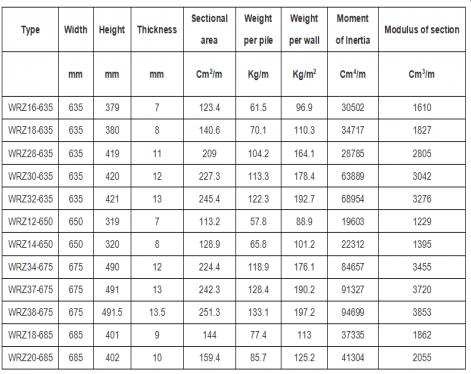
Z-Type Sheet Piles
Flat Web Sheet Piles
| Type | Width (mm) | Height (mm) | Thickness (mm) | Sectional Area (cm²/m) | Weight per Pile (kg/m) | Weight per Wall (kg/m²) | Moment of Inertia (cm⁴/m) | Modulus of Section (cm³/m) |
| FSP-400 | 400 | 100 | 7 | 28.7 | 22.5 | 56.3 | 730 | 146 |
| FSP-500 | 500 | 125 | 8 | 41.6 | 32.6 | 65.2 | 1,580 | 253 |
| FSP-600 | 600 | 150 | 9 | 56.7 | 44.5 | 74.2 | 2,920 | 389 |
| FSP-700 | 700 | 180 | 10 | 76 | 59.6 | 85.1 | 5,410 | 601 |
| FSP-800 | 800 | 200 | 12 | 102.2 | 80.2 | 100.3 | 8,520 | 852 |
Common International Steel Sheet Pile Standards
Japanese StandardJIS A 5523
Common models: SP-II, SP-III, SP-IV, SP-VL
European Standard
EN 10248
Widely used in marine and infrastructure projects
American Standards
ASTM A572
ASTM A690
ASTM A328
Frequently Asked Questions
What is the standard size of steel sheet piles?Common widths range from 400 mm to 700 mm, while section depths typically range from 100 mm to 500 mm depending on profile type.
Which is stronger: U-type or Z-type sheet piles?
Z-type sheet piles generally provide higher section modulus and better structural efficiency, especially for deep retaining systems.
How long do steel sheet piles last?
With proper corrosion protection, steel sheet piles can last 50 years or more in many environments.
Are steel sheet piles reusable?
Yes. One major advantage of steel sheet piles is their ability to be extracted and reused in temporary projects.